
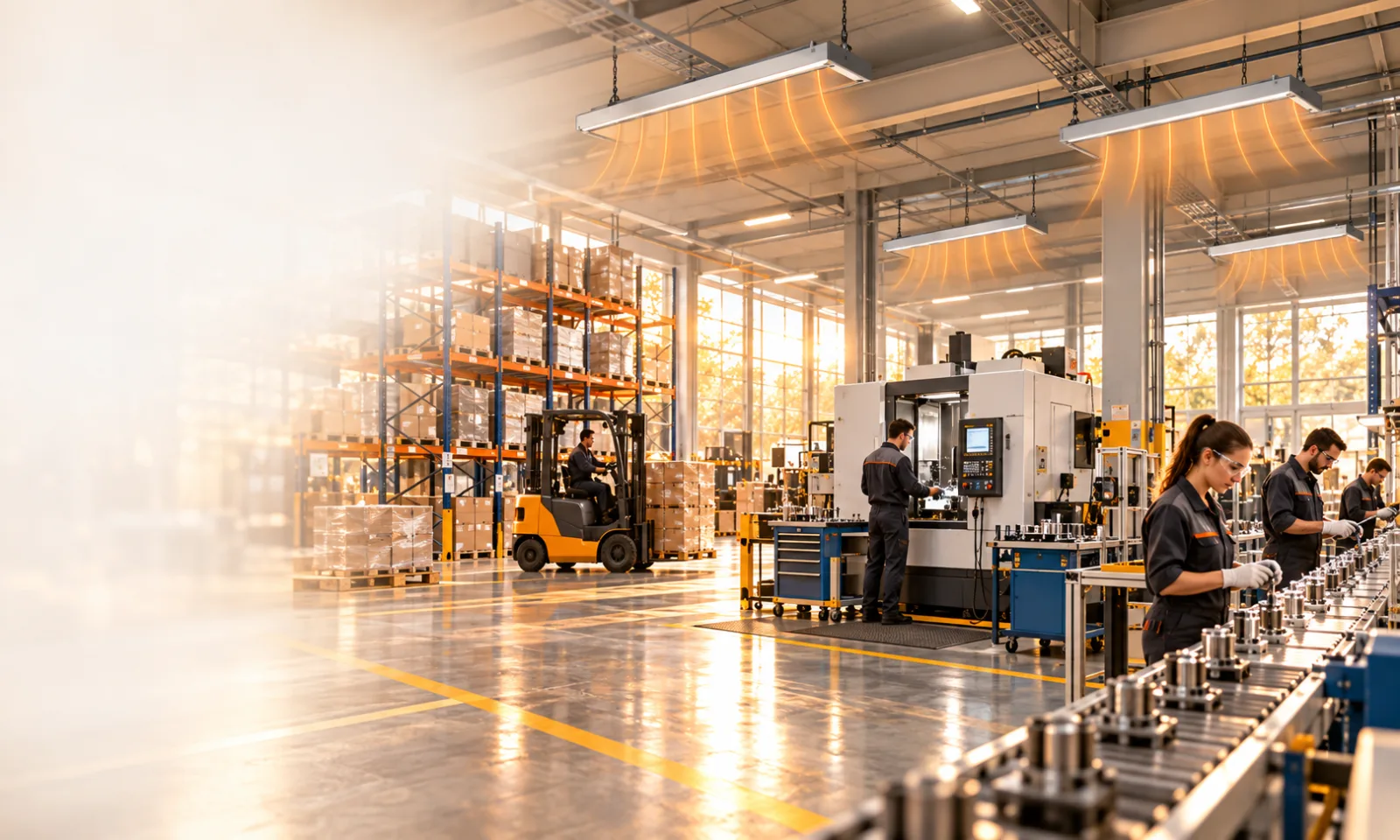
Workshops · Warehouses · Production facilities
High ceilings, opening gates and workstations in different parts of a building make heating a production facility difficult. One workshop needs a set temperature across its whole floor area, while another only needs warmth at a few stations. The choice of system depends on that difference.
Teplov industrial infrared heaters are used for main, zonal and supplementary heating. They are positioned according to heat loss, room height, equipment and operating mode. Heat loss calculation and consultation are free of charge.

If a set temperature is required throughout a workshop or storage area, the heaters are distributed across the space. The system has to compensate for the calculated heat loss, and the electrical network has to supply the required power. The number of heaters is determined by more than floor area: an insulated workshop and a cold hangar of the same size need different solutions.
If people work at machines or at repair, packing or sorting stations, local heat zones can be organised. Separate groups of heaters make it possible to match heating to the operation of each area. This approach is appropriate when identical conditions are not required throughout the whole building.
Infrared heaters can be used in a cold area or for a new workstation. Before selecting them, it is important to establish why the existing heating is insufficient: a shortage of capacity, draughts, significant heat loss or poor heat distribution.
An infrared heater transfers part of its thermal energy by radiation to surfaces and people within its range. The heated surfaces then also release warmth into the surrounding air. This allows heating to be directed to the required area instead of relying solely on heat carried by air flows.
Where are the limits of this solution? Infrared heating does not eliminate losses through the roof, walls, ventilation or open gates. Racking and equipment can block the radiation. That is why not only the power of the heaters matters, but also their positions and the conditions of the building.
For production, the first step is to define the requirements of people, equipment and the technological process. If employees are permanently in specific places, zonal heating is worth considering. If the process requires a set temperature throughout the building, appropriate general heating is needed. The layout is agreed with the machines, utilities and the movement of goods.

In a warehouse, staff comfort and product storage conditions need to be distinguished. Heating the packing area does not guarantee the required temperature on every level of the racking. For general heating, the layout, storage height, gates and product requirements are taken into account.

For service premises, work stations, vehicle lifts, vehicle movement and the opening of gates are important. Ceiling heaters can warm the required areas without occupying the floor. However, they do not block draughts: air loss through the gates and the possibility of reducing it are assessed separately.

The heaters are fixed under the ceiling or on suitable structures of the building. The height, distances and fixing method are determined by the requirements of the specific model. The heaters are grouped by work zone; the automation and sensor positions are selected to suit the conditions of the premises.
For example, the Amitell workshop heating project describes the use of six BE4000 and three BE3000 heaters mounted on roof trusses at a height of 6 m. This is an example of a specific installation, not a universal set-up for any workshop.
Before installation, a check is made that racking, equipment and goods do not block the area covered by the heaters. Cable routes, protection and the permissible load on the electrical network are determined separately.
Electric convectors and fan heaters mainly transfer heat to the air. When choosing them, heat distribution, air movement and, for fan-driven units, noise are important. For some tasks, an advantage of the infrared solution may be directed heating of the work zone. At the same time, an infrared heater does not guarantee lower costs merely because it transfers heat in a different way.
Water heating from a boiler is worth evaluating if the company already has a suitable boiler house and network. The condition of the system, fuel, maintenance and modernisation costs are compared. Electric infrared heaters make it possible to organise heating without a new water circuit, but they require sufficient electrical capacity.
A heat pump should also be considered when choosing electric heating: under suitable conditions it can use less electricity to supply the required amount of heat. What needs to be compared is output in cold weather, how the heat is distributed, the initial cost and backup provision.
For a well-founded choice of system, the options are compared for the same task: temperature, heated zones, operating schedule and external conditions.
The price of a single heater is not the cost of a finished system. Current prices and specifications can be found in the catalogue of ceiling infrared heaters and in the model cards for industry on this page.
The overall budget depends on:
It is therefore advisable to request a quotation broken down into equipment, connection and labour. A price “per square metre” without data about the building is not a reliable guide for a specific company.
For a heater with constant power, the energy consumed while it is switched on equals its power in kilowatts multiplied by the hours of actual operation. For the whole system, the consumption of the individual heaters is added up. The cost of energy is determined by the applicable tariff; other charges are accounted for separately.
A company’s working hours do not always equal the hours the heaters are switched on. Costs are affected by the weather, insulation, the required temperature, the opening of gates and the control settings. Zoning and a schedule coordinated with operations can reduce costs, but promising a fixed percentage of savings without a comparative calculation would be incorrect.
Compare your own task with sites of a similar purpose. The photographs and descriptions of conditions will help you understand how the equipment is positioned in real premises.
Further examples can be found in the Teplov portfolio.
Teplov manufactures infrared heaters and helps select equipment to suit the conditions of the site. For a substantive consultation, please prepare:
Specialists will help determine the required power, number and positioning of the heaters. The configuration, installation and timing are agreed for the specific site. Equipment documents and warranty terms can be found in the “Certificates” and “Warranty” sections.
Contact Teplov for a free consultation and heat loss calculation.

For an office, shop or showroom next to a production site, different heating modes and equipment placement requirements may be needed. Choose the relevant category:
It can be, but the permitted mounting height depends on the specific model. Radiation intensity in the occupied area, even coverage and obstructions must be considered. There is no single mounting height suitable for every heater.
Yes, provided the production process and storage requirements do not call for the same temperature throughout the building. Heaters are positioned above the required areas, with separate group controls where appropriate.
Yes. Infrared heaters can provide supplementary heat in particular areas. Their capacity and controls should be coordinated with the existing system and required operating conditions.
Electric heaters stop producing heat. Where continuous heating is critical, backup provision must be planned separately, taking account of the required capacity and operating duration.
This depends on the manufacturer’s requirements, site conditions and the installers’ qualifications. Fixings, placement and electrical connections must follow the instructions for the specific model. Installation arrangements should be agreed before ordering.
Confirm the complete equipment package and scope of work in the quotation for your site. The price of an individual heater should not automatically be treated as the cost of a system with controls, electrical connection and installation.

Price: UAH 8,400.00

Price: UAH 11,300.00

Price: UAH 11,700.00

Price: UAH 11,900.00

Price: UAH 15,600.00

Price: UAH 16,100.00

Price: UAH 16,100.00

Price: UAH 16,500.00

Price: UAH 27,300.00

Price: UAH 30,000.00


13 July 2021
Ceiling heaters BiLux Ukraine lost a patent dispute to Ukrprom Company, the owner of intellectual rights to infrared heaters TM Teplov
See more01 July 2020
Vinnitsa National Technical University conducted research on modern heating systems in industrial premises
See more28 January 2020
Dear friends! Today we celebrate the anniversary! For 15 years we have been producing energy-efficient heating.
See more09 August 2018
We figured out the products of two manufacturers of ceiling heaters. Comparison of an infrared heater Bilux B1350 and Teplov B1350
See more


