
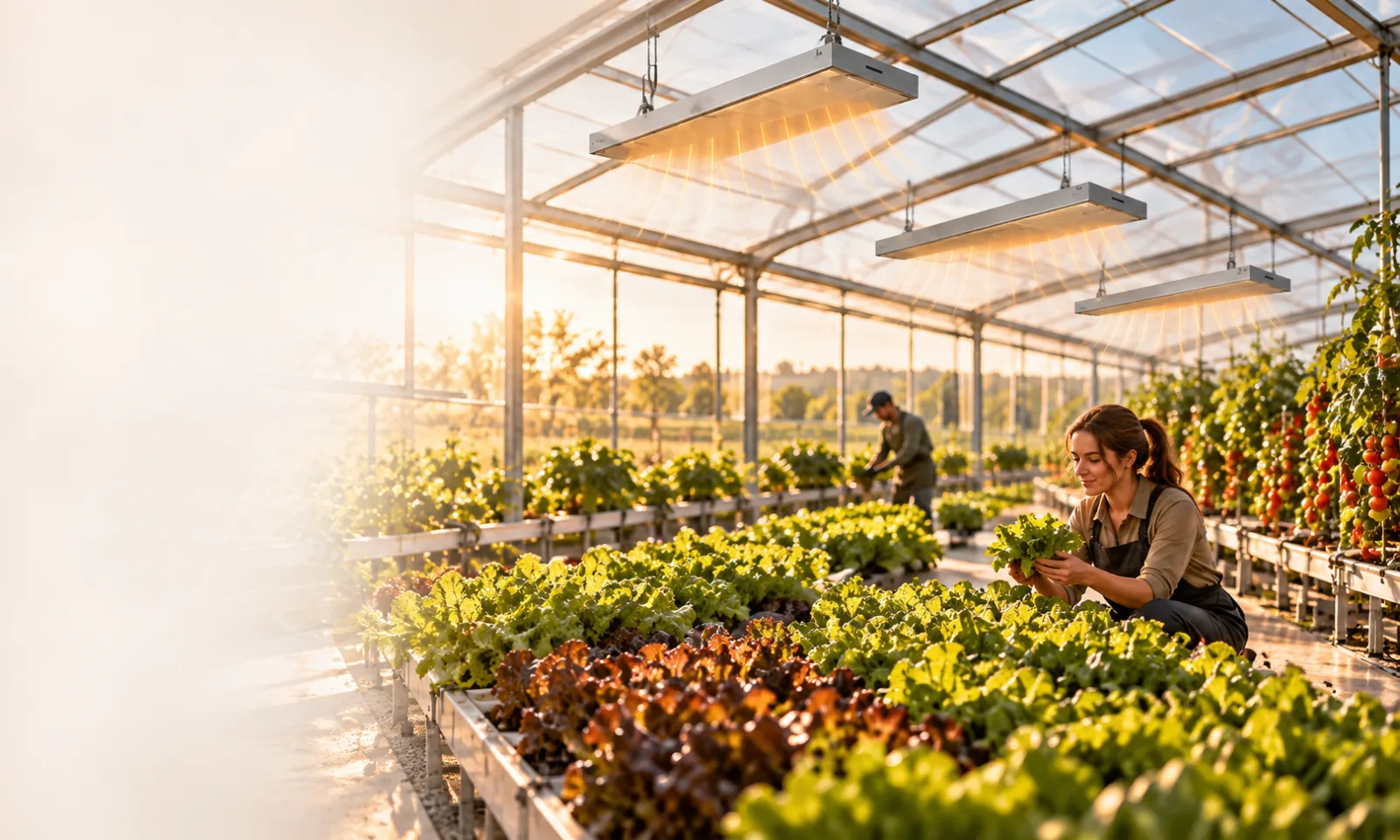
Greenhouses · Farms · Livestock buildings
Modern agriculture is unimaginable without reliable, economical, and efficient heating. In greenhouses, cow barns, pigsties, incubators, grain storage facilities, and other agricultural buildings, maintaining a stable temperature is not just about comfort — it's a critical factor for productivity and the preservation of crops and livestock. TM Teplov offers a unique solution — infrared electric ceiling heaters adapted to the needs of Ukraine’s agricultural sector.
1. Up to 60% energy savings
Teplov infrared heaters warm not the air but surfaces — floors, walls, equipment, and living organisms. This minimizes heat loss and reduces heating costs, even in non-insulated buildings.
2. Localized and zoned heating
Unlike convection systems, infrared heat works directionally. You can heat only the work areas, animal stalls, or specific greenhouse zones with plants or young animals, without wasting energy on the entire room.
3. Easy installation and maintenance
Infrared heaters require no complex projects or infrastructure. They are mounted on the ceiling, saving valuable floor space and avoiding interference with machinery or personnel movement.
4. Durability and resistance to harsh environments
Teplov heaters are made from high-quality materials resistant to moisture, dust, and ammonia, making them ideal for livestock facilities.
5. Safe for animals and plants
The radiation from infrared heaters mimics natural sunlight, causing no stress to animals and not drying the air — which is especially important for heating greenhouses and incubators.

1. Greenhouses
Sustainable greenhouse operations require consistent temperatures. Ceiling-mounted Teplov heaters provide targeted heat that ensures optimal plant growth, even when it’s freezing outside. Additionally, infrared heating helps prevent condensation and mold.
2. Cow barns, pigsties, poultry houses
Animals are sensitive to temperature changes. Infrared heating systems help maintain a stable microclimate, reduce the risk of disease, improve appetite and weight gain — increasing the profitability of livestock farming.
3. Incubators and poultry houses
IR heating delivers even warmth without drafts — crucial for raising chicks, poults, or ducklings. Uniform heat supports healthy development and reduces mortality rates.
4. Storage and warehouse facilities
Grain storage and warehouses require controlled dryness and temperature. Teplov infrared heaters prevent mold and dampness, helping maintain the quality of agricultural products.
Teplov solutions are already used on farms across Ukraine — from small greenhouses in Zakarpattia to large dairy complexes in Poltava region. Easy operation, high energy efficiency, and reliable performance make infrared ceiling heaters an ideal choice for the agricultural sector.
• Manufactured in Ukraine
• Up to 10 years warranty
• Personalized consultation and equipment selection
• Can operate on generators or solar panels
• Compliant with energy-saving standards and regulations
We’ll help you choose the optimal heating system for your farm. Contact us — our specialists will advise you on how many heaters you need, where to place them, and how to save on heating this season.
Infrared heating for agriculture from Teplov — it's not just warmth, it's peace of mind. Grow, feed, and develop — we’ll take care of the rest.
For a shop, an office, a factory or a home, heating conditions differ from those of a greenhouse or a livestock farm: operating mode, comfort requirements, equipment placement and power needs are all different. Choose the relevant category:
Yes. Infrared heaters are used in greenhouses to maintain the required temperature in cold weather and to protect plants from freezing. The heat is directed at the soil, plants and structures, which in turn warm the air. Whether this is enough for winter growing depends on heat loss: the covering (film, polycarbonate, glass), the frame, the region and the crop’s requirements. See examples in our portfolio: heating an 80 m² greenhouse in the Vinnytsia region and heating a polycarbonate greenhouse.
The number is determined by heat loss, not by floor area alone. The main factors are the minimum outdoor temperature, wind, the material and number of covering layers, the height of the greenhouse and the temperature your crop requires. The heated area listed in the catalogue is a guideline for typical conditions, so the final power and layout should be agreed with specialists. Consultation and calculation are free: contact Teplov.
Yes. They are used for spot heating of young birds and as additional or main heating for the building. Day-old chicks need a much higher temperature than adult birds, so zoning makes it possible to create a warm area without heating the whole house to that temperature. Mounting height and power are chosen according to zootechnical standards for your species, breed and age of birds, and the characteristics of the model. Near litter, dust and feed, it is important to keep the minimum distances given in the instructions.
Yes. Spot infrared heating of resting areas for piglets and calves is a common application. Newborn piglets need a much higher temperature than sows, so zone heating provides warmth where it is needed without raising the temperature of the whole room. The heaters are mounted so that animals cannot reach them, and cables are protected. Farm conditions (humidity, dust, ammonia vapour) are harsher than in domestic premises, so confirm the suitability and protection rating of a model with specialists before ordering. Heating the whole building requires a separate heat-loss calculation.
Yes, but the storage regime has to be taken into account. For many products the goal is not “room” temperature but keeping a few degrees above zero: excess heat can cause sprouting and spoilage. This calls for temperature sensors, ventilation and humidity control. An infrared heater acts on the surfaces within its radiation zone rather than on an entire stack or pile, so the layout for high racking is planned separately. Near hay, straw, shavings and dust, minimum distances and proper electrical protection are required. An example of a non-standard application is infrared grain drying.
Energy consumed equals the heaters’ power in kilowatts multiplied by the hours they actually operate. With a thermostat, the heaters switch on only when needed, so running hours are lower than the hours in a day. For some models the catalogue lists rated and consumed power separately: compare models by both figures in the catalogue of ceiling heaters. A fixed percentage of savings cannot be stated without a calculation for a specific site. When powered by a generator or solar panels, the capacity of the source must cover the total load of the heaters with a margin. Without a backup source, heating stops during a power outage.

Price: UAH 5,100.00

Price: UAH 5,400.00

Price: UAH 6,900.00

Price: UAH 7,200.00

Price: UAH 11,700.00

Price: UAH 11,900.00

Price: UAH 16,100.00

Price: UAH 17,100.00


13 July 2021
Ceiling heaters BiLux Ukraine lost a patent dispute to Ukrprom Company, the owner of intellectual rights to infrared heaters TM Teplov
See more01 July 2020
Vinnitsa National Technical University conducted research on modern heating systems in industrial premises
See more28 January 2020
Dear friends! Today we celebrate the anniversary! For 15 years we have been producing energy-efficient heating.
See more


