Customer Service Area Heating with Infrared Heaters

Commercial premises are not always used as one uniform space. In many service and retail facilities, clearly defined areas are used by customers and employees throughout the working day.
These may include customer service areas, reception desks, order collection and dispatch points, operator workstations, checkout areas and waiting zones.
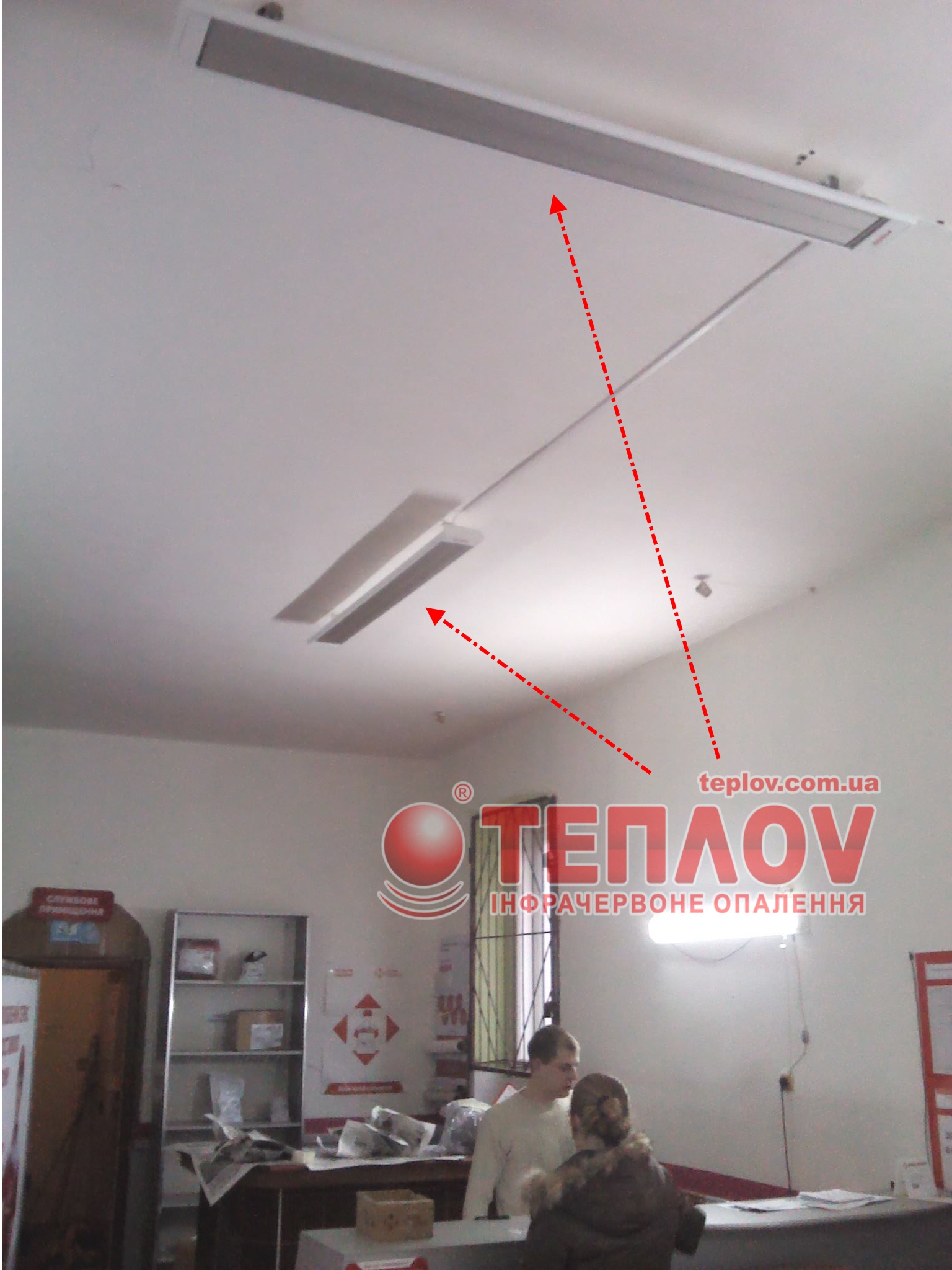
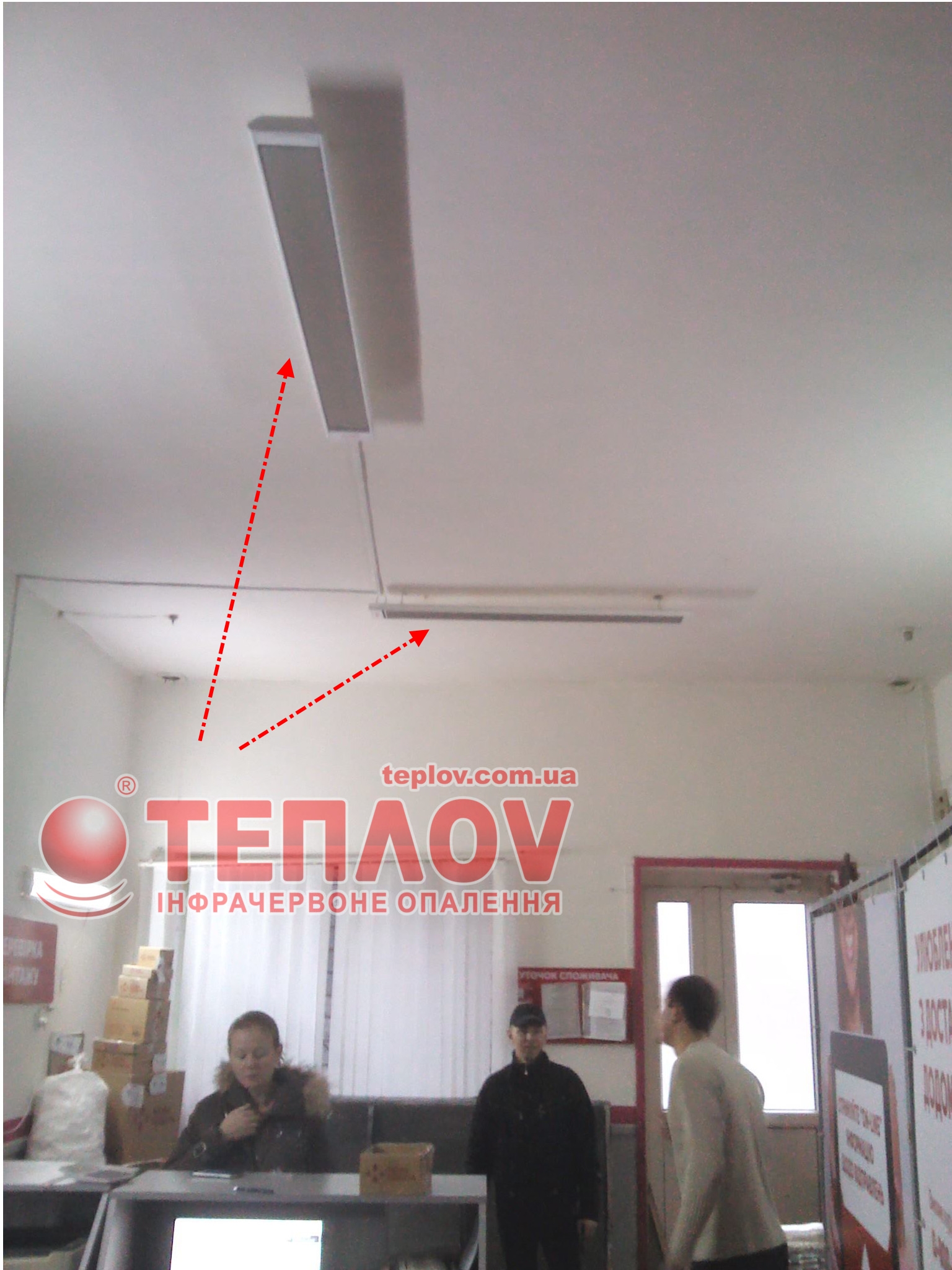
This type of functional layout was present in one of Teplov's projects completed in Zakarpattia, Ukraine, in 2016. Infrared heaters were installed at two service branches in Perechyn and Velykyi Bereznyi.
The project is an example of how heating can be considered not only in terms of the total floor area, but also in relation to the actual way people use the space.
Customer and Staff Areas
The photographs from the project clearly show two connected functional areas: a customer-facing area and a working area for staff.
Customers need comfortable conditions while waiting and receiving a service. Employees need stable thermal comfort at their workstations throughout the working day.
In such premises, these requirements are closely connected, but heat demand is not necessarily uniform across the entire room. The situation becomes particularly important when entrance doors are opened frequently.
This is where zoned heating can be useful: instead of treating the entire building as one identical thermal space, the heating system can be designed around the areas where people actually spend their time.
Why Infrared Heating Can Work Well in Service Areas
Infrared heating transfers thermal energy to surfaces and objects within the radiation zone rather than relying solely on heating and circulating the air.
This makes infrared heating suitable for applications where comfort is required in clearly defined areas.
Potential applications include:
- customer service areas;
- reception desks;
- operator workstations;
- order collection and dispatch areas;
- checkout areas;
- waiting areas;
- retail and service premises;
- workstations close to frequently opened doors.
The main principle is simple: the heating system should correspond to the way the premises are actually used.
Heating Areas with Frequently Opened Doors
Service facilities can experience considerably more door opening than a conventional office.
Every time an entrance door is opened, outside air enters the building and additional heat losses may occur. This is why the operating conditions of a commercial premises should be considered when designing its heating system.
Important factors include:
- floor area and ceiling height;
- wall, roof and window characteristics;
- number and size of doors;
- frequency of door opening;
- working hours;
- location of workstations;
- number of people regularly present;
- required indoor temperature;
- calculated heat losses.
For this reason, selecting heaters based only on floor area is not sufficient for a reliable commercial heating design.
Teplov B1350 in the Project
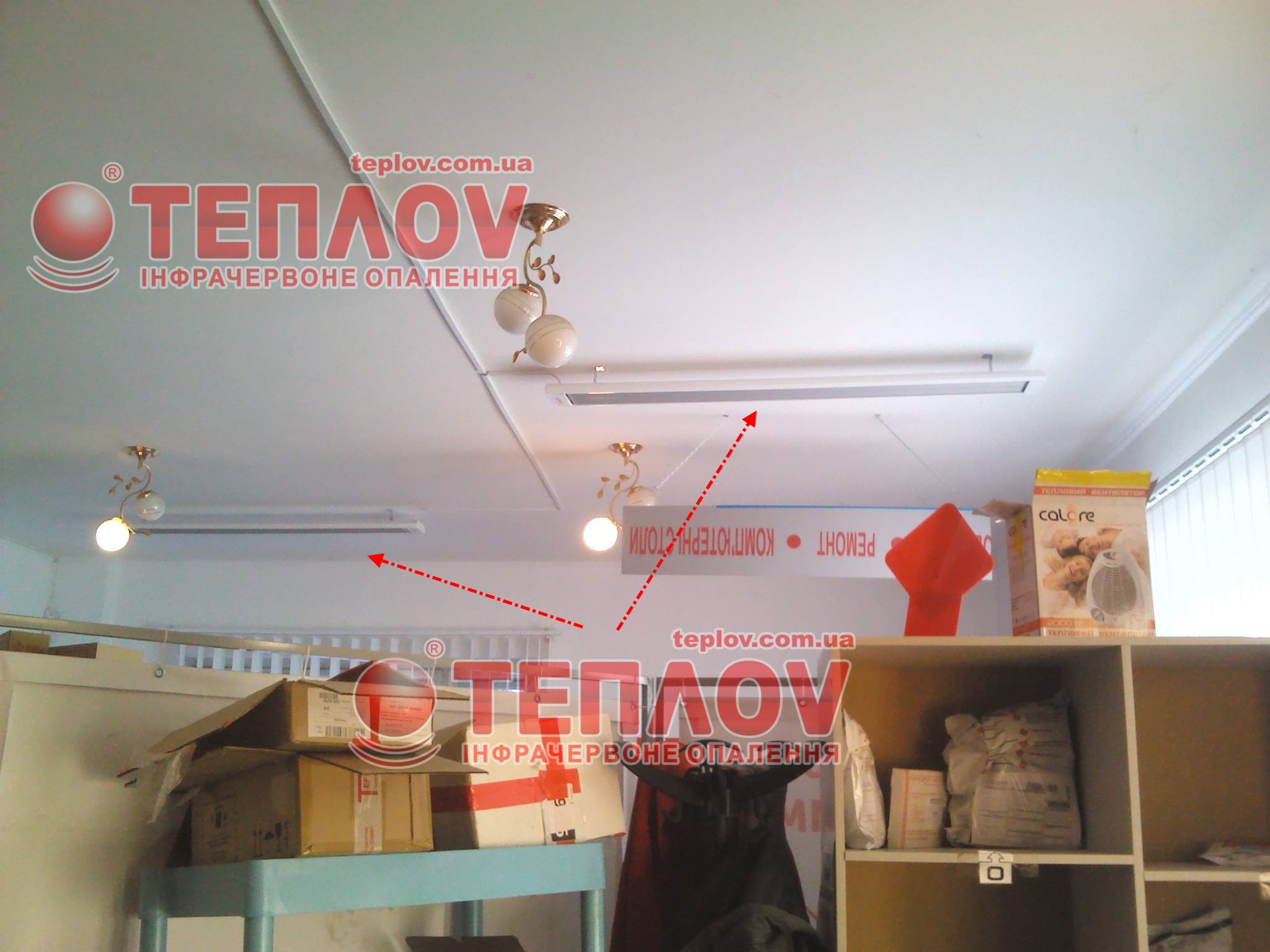
The project used three Teplov B1350 infrared heaters.
The current B1350 specification lists a rated power of 1300 W. Three units therefore represent a total rated installed power of 3.9 kW.
The B1350 belongs to Teplov's range of long-wave infrared heaters. The model is primarily designed for ceiling installation and can also be used for local heating of workstations.
For commercial premises, ceiling-mounted infrared heating can preserve valuable floor space and allows the heating system to be coordinated with the functional layout of the room.
Designing Heating Around the Function of the Space
Every commercial premises has its own layout, building characteristics and operating pattern. Therefore, the same number of heaters will not necessarily provide the same result in different buildings.
The first step is to define the actual heating requirement.
Is the objective to heat the entire room, or is the main requirement to provide comfort in a specific customer service area and staff workspace?
The next step is to assess heat losses, ceiling height, doors, windows, occupancy and the position of workstations.
Only after these factors are considered should the required heater output, quantity and positioning be determined.
This approach connects the heating system with the actual function of the premises rather than treating the room simply as a number of square metres.
A Real Teplov Project in Zakarpattia
The project was completed in 2016 at two service branches in Zakarpattia, Ukraine.
It demonstrates one of the practical applications of infrared heating in a commercial environment: creating comfortable conditions in a space simultaneously used by customers and employees.
Teplov also has other functional-zone projects, including infrared heating of checkout areas in METRO hypermarkets.
Infrared Heating for Customer Service Areas
If a commercial premises requires heating for a customer service area, staff workstation or another defined functional zone, the heating system should be selected according to the actual characteristics of the building.
Teplov can help determine the required equipment based on the premises' heat losses, dimensions, ceiling height, operating conditions and functional layout.